This post draws on “Biologics and Biosimilar Litigation 2026: Lessons from India, the UPC, Europe and the USA”, presented by Dr. Malathi Lakshmikumaran, Ph.D., FNASc, F-STEM, Executive Director, LKSLAW, on 17 November 2026 in our webinar series.
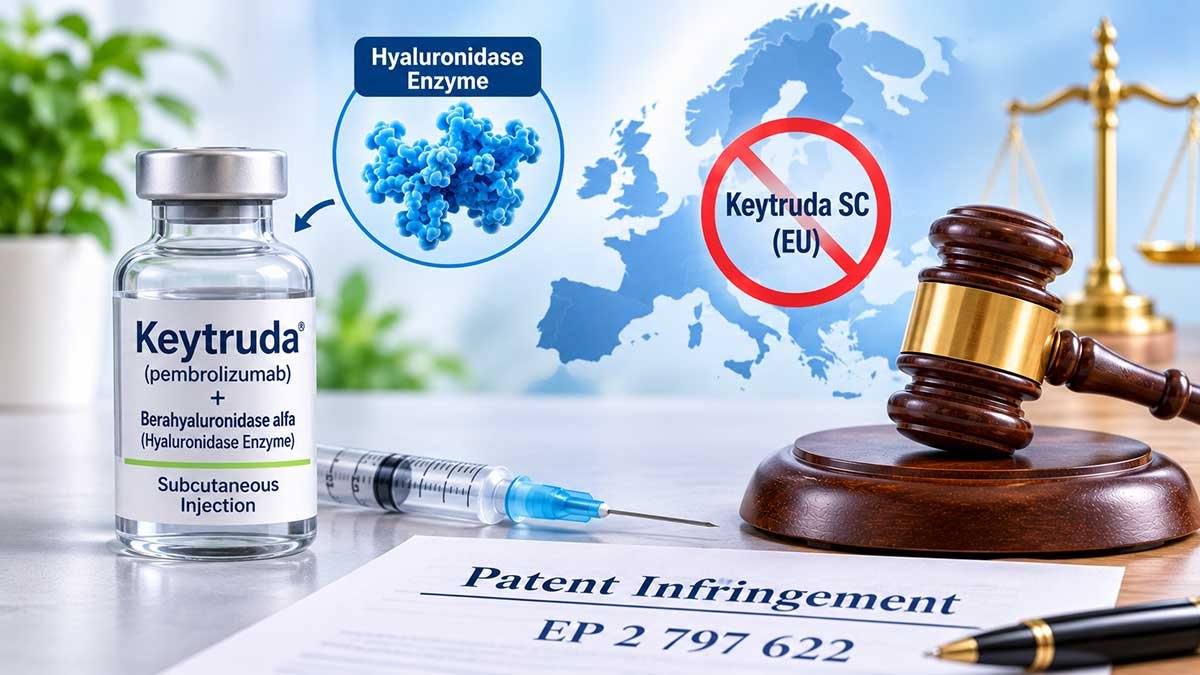
Subcutaneous Keytruda is now off the market in much of Europe, and the reason has nothing to do with pembrolizumab. In early October 2026, the District Court of The Hague held that MSD’s subcutaneous Keytruda infringes a Halozyme patent on the enzyme that makes injection under the skin possible. MSD’s European hub was ordered to stop supplying the product in eight countries.
What the fight is about
Keytruda has long been given as an intravenous infusion. Keytruda SC, approved in the EU in November 2025 and sold in the US as Keytruda Qlex, combines pembrolizumab with berahyaluronidase alfa, a hyaluronidase enzyme developed by Alteogen. Enzymes of this kind break down hyaluronan in the tissue under the skin, so a large volume of drug can be injected rather than infused.
Halozyme says that enzyme falls within its European patent EP 2 797 622 (“EP 622”), one of its MDASE patents on modified PH20 hyaluronidase. The patent expires on 27 December 2032. Halozyme is better known for its ENHANZE licensing programme, but it has made clear that the MDASE patents are separate from ENHANZE.
In the Netherlands, it was MSD that started the case, asking the court to declare that it does not infringe and to revoke the Dutch part of EP 622. Halozyme counterclaimed for infringement.
How it unfolded
MSD went on the offensive first. In August 2025 it filed revocation actions against EP 622 in the German Federal Patent Court and the UK High Court. Keytruda SC was approved in the EU in November 2025, and on 4 December 2025 Halozyme won a preliminary injunction in the Munich Regional Court, which found imminent infringement and stopped the German launch.
The Netherlands was less straightforward for Halozyme at first. It asked The Hague for a quick injunction covering Denmark and Sweden, where MSD had listed Keytruda SC in national pricing databases. Halozyme’s argument rested on MSD’s own pleadings, which had called Halozyme’s claim that MSD would launch as fast as possible “unfounded and incorrect”. Halozyme said that amounted to a promise not to launch. On 14 July 2026, the court disagreed: the statement was not a binding undertaking, and the injunction was refused.
The main case was heard on 31 July 2026, and the judgment came in early October.
The October judgment
The court rejected MSD’s invalidity arguments and found that Keytruda SC infringes EP 622. It ordered MSD BV, MSD’s central EU marketing authorization holder and its packaging and distribution hub, to stop making, offering, marketing, importing, stocking or otherwise distributing Keytruda SC in Belgium, Denmark, France, Ireland, Italy, Sweden, Switzerland and the Netherlands. MSD BV may not use its European marketing authorization to help affiliates infringe either.
Patients are not left without the drug. The intravenous form of Keytruda is not covered by the patent and remains available. Merck said it strongly disagreed with the decision.
Meanwhile, in the US
Halozyme has also sued Merck in the District of New Jersey, alleging that Keytruda Qlex infringes 15 MDASE patents. Merck is challenging those patents at the US Patent Trial and Appeal Board. On 12 May 2026, the Board invalidated US Patent No. 11,952,600 for lack of enablement and written description, and more challenges are pending.
Why this matters
As core patents on blockbuster biologics near expiry, originators are moving them from infusion to injection. That switch usually depends on someone else’s delivery technology, and this case shows how much that technology can be worth, and how hard its owner can fight for it. A patent on an enzyme has kept subcutaneous Keytruda off the market in nine European countries, Germany included.
It also shows how differently courts handle timing. Munich acted before launch; The Hague refused a quick injunction, then granted broad relief after a full hearing. And by aiming at the company that holds the EU marketing authorization, Halozyme got one Dutch judgment to reach eight markets.
For anyone developing a subcutaneous biologic, whether originator or biosimilar maker, the lesson is to clear the delivery technology as carefully as the antibody. The US validity fight is still open, so this story is not finished.