This post draws on “Biologics and Biosimilar Litigation 2026: Lessons from India, the UPC, Europe and the USA”, presented by Dr. Malathi Lakshmikumaran, Ph.D., FNASc, F-STEM, Executive Director, LKSLAW, on 17 November 2026 in our webinar series.
On 14 October 2026, a federal court in New Jersey quietly dismissed Genentech’s patent suit against Biocon over Pebrilzo, Biocon’s version of the breast cancer drug Perjeta (pertuzumab). The two companies had settled worldwide. It was the latest in a run of pertuzumab disputes that have now played out in India, at Europe’s Unified Patent Court and in the US.
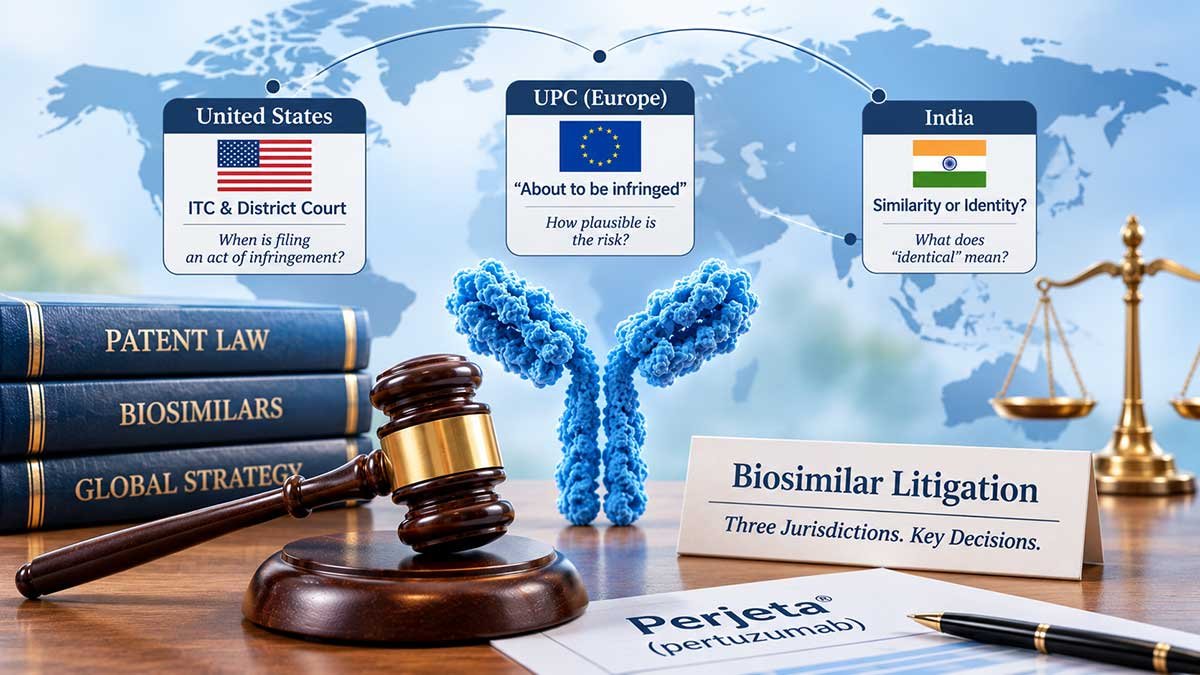
What is striking is how differently each forum approached essentially the same problem. Delhi wanted to know whether the biosimilar was identical to the product of the patented process. The UPC asked whether the patent was about to be infringed. In the US, the question barely arises: filing for biosimilar approval is itself treated as an act of infringement.
Why pertuzumab is contested
Pertuzumab targets HER2 and is used to treat HER2-positive breast cancer. Roche and Genentech protect it with several layers of patents: formulations, variants of the antibody (including acidic and disulphide-reduced variants), manufacturing processes and treatment regimens. In India, the formulation patent IN 268632 expired on 19 October 2025, but the process patent IN 464646 runs until 15 April 2034. That gap is where much of the litigation sits.
The US: an ITC complaint, a 28-patent suit, then a deal
Genentech’s first move against Biocon was not in a district court at all. On 27 February 2026, it filed a complaint at the US International Trade Commission, alleging that Biocon had imported more than 17,800 units of its pertuzumab biosimilar from India on 18 October 2025, before FDA approval. Genentech said that was stockpiling for launch, not activity protected by the safe harbour in § 271(e)(1). It asserted four patents: US 8,652,474 and 11,597,776, on compositions with defined acidic variants and methods of making them, and US 12,145,997 and 12,173,080, on preventing disulfide bond reduction during manufacture.
The main suit followed on 29 July 2026. After the pre-litigation information exchange the BPCIA requires, Genentech and Hoffmann-La Roche sued Biocon in the District of New Jersey on 28 patents covering pertuzumab, its use and its manufacture. They pleaded that Biocon’s abbreviated BLA was itself an act of infringement under 35 U.S.C. § 271(e)(2)(C), and asked for injunctions and damages.
Less than three months later it was over. On 14 October 2026, the court dismissed all claims without prejudice, and Biocon announced a global settlement and licence resolving its disputes with Genentech in the US, Canada and elsewhere. Biocon can launch Pebrilzo in the EU and UK from the first quarter of 2027, in the US from the third quarter of 2028, and in other markets between 2026 and 2028, subject to regulatory approval. No court ruled on infringement or validity.
The UPC: “about to be infringed” means what it says
In Europe, the fight was with Organon, which licensed its biosimilar, HLX11, from Shanghai Henlius. The EMA validated their marketing authorization application in March 2025. On 28 April 2025, Organon’s US counsel wrote to Genentech and Roche that Organon intended to launch across Europe once approved, and wanted legal certainty on Roche’s pertuzumab patents.
Genentech and Roche moved quickly. On 6 May 2025 they applied to the UPC’s Brussels Local Division, without notice to Organon, for orders to preserve evidence and inspect Organon’s manufacturing sites in Belgium and the Netherlands. They relied on EP 3 401 335, a divisional of EP 2 238 172, which covers compositions of an antibody that binds domain II of HER2 together with its acidic variants. The court granted the orders on 30 May 2025, and they were carried out on 27 June 2025.
Organon asked the court to review them. Its argument was that “about to be infringed” means imminent, and that without a marketing authorization the orders were premature. On 12 November 2025, the court disagreed and confirmed the orders. It treated “about to be infringed” under Article 60 of the UPC Agreement as a stand-alone test, separate from the urgency needed to act without hearing the other side. The applicant has to show a certain degree of plausibility that infringement will happen, and here the validated application and Organon’s own statements about launching across Europe were enough, even though no authorization had yet been granted.
Genentech, Organon and Henlius later settled their pertuzumab litigation in the US, the UPC, the Netherlands and Brazil, as reported in January 2026.
India: similar is not identical
The Indian case took a different turn. Roche sued Zydus over Sigrima, its pertuzumab biosimilar, and relied on Section 104A of the Patents Act, 1970. That provision can shift the burden of proof in a process patent case, so that the defendant has to show its process does not infringe. Roche wanted Zydus’s manufacturing process disclosed to a confidentiality club.
In a judgment pronounced on 23 July 2025, Justice Amit Bansal of the Delhi High Court said no. The burden shifts only if the patentee first shows that the defendant’s product is identical to the product directly obtained by the patented process. Parliament chose the word “identical”, and the court would not read it down to “similar”. A biosimilar approval shows comparable quality, safety and efficacy; it does not show an identical composition or an identical process.
Roche’s evidence did not get it over that line. Its own case was that IN 464646 produces pertuzumab together with specific variants, while Zydus’s regulatory filings referred only to pertuzumab. Roche had not analyzed Sigrima after launch, and the fact that Zydus used Perjeta as its reference product was not enough. On the formulation patent IN 268632, Roche’s own mapping showed that Zydus uses an arginine citrate buffer, while the patent claims a histidine acetate buffer. The court added that Section 104A cannot be used to find out whether infringement has happened, and that the Patents Act, as a special statute, prevails over the general discovery provisions of the Code of Civil Procedure.
Roche has appealed to the Supreme Court (SLP (C) No. 31000/2025). The matter was heard on 12 January 2026 and re-listed, and no final decision has been reported.
Three forums side by side
| United States | UPC | India | |
| When the patentee can act | On filing of the aBLA; at the ITC, on importation | Once infringement is plausibly about to happen | Before or after launch; here, after launch |
| What the regulatory filing proves | The aBLA is the statutory act of infringement | The MAA is evidence of intent, not of infringement | Biosimilarity proves similarity, not identity |
| Access to the biosimilar maker’s process | Through the BPCIA information exchange | Court-ordered preservation and inspection | Refused without proof of identity |
| How it ended | Global settlement with licensed entry dates | Global settlement | Appeal pending |
What to take from it
If you are an originator, each forum gives you a different early tool. The UPC can secure evidence before launch, the US puts the whole patent estate in play early, and the ITC can reach stock imported before approval. In India, a process patent claim needs real evidence of identity; a biosimilar approval will not do the work for you.
If you are a biosimilar maker, especially one exporting from India, you are dealing with three rulebooks for one product. Your manufacturing know-how may be well protected in India unless the patentee can show identity. In Europe, letters and licence deals announcing a launch can justify an inspection. And in the US, shipping commercial quantities before approval can bring an ITC complaint.
The one thing still open is in India. When the Supreme Court decides Roche’s appeal, we will know whether the strict identity test under Section 104A survives.