This post draws on “Injunctions in pharma: Ex parte relief near expiry (ruxolitinib), and API supplier listings and stockpiling as evidence”, presented by Mishthi Dubey, Associate Partner, Saikrishna & Associates, on 18 November 2026 in the ipEssentia Webinar Series 2026.
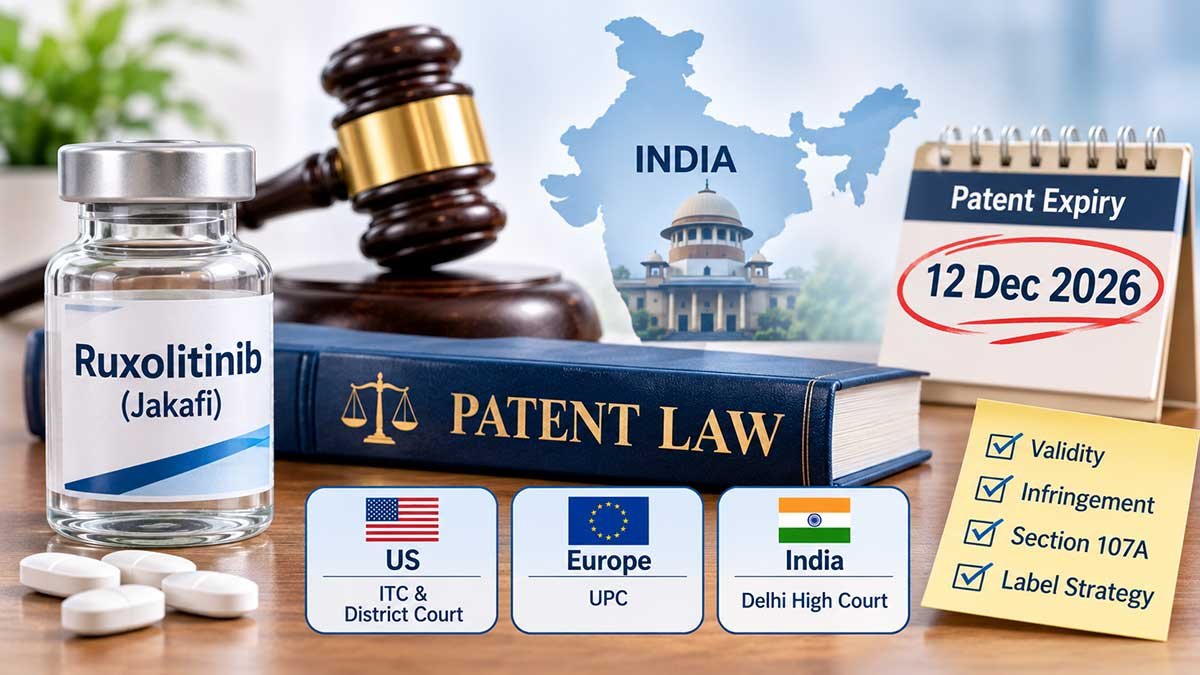
Incyte’s Indian patent on ruxolitinib expires on 12 December 2026. With so little time left, you might expect a patentee to sit back and wait it out. Incyte has done the opposite. Since late 2023 it has taken at least eight Indian companies to the Delhi High Court, and this year it won two more injunctions without the other side being heard: against Aurore Life Sciences in July and Melody Healthcare in September.
What makes these last two orders worth a closer look is what they rested on. Neither company had launched a product. Both had advertised ruxolitinib API, appeared as suppliers on an industry website and obtained state manufacturing licences. That was enough.
A patent with weeks to run
Indian Patent IN 269841 covers ruxolitinib itself (claim 1), its pharmaceutically acceptable salts (claim 17) and compositions containing it (claim 21). It comes from an international application filed on 12 December 2006 and was granted on 10 November 2015. Incyte Holdings Corporation sues together with two Novartis group companies. The drug, used to treat myelofibrosis, has been sold in the US as Jakafi since 2011 and in India as Jakavi since 2013.
When Incyte sued BDR Pharmaceuticals in December 2023, the court remarked that the patent had stood unchallenged for 17 years.
Three years, eight defendants
Here are the orders we could confirm, most recent first.
| Date | Defendant | What the court did |
| 24 September 2026 | Melody Healthcare, CS(COMM) 1054/2026 | Ex parte injunction, covering stockpiling and export |
| 27 July 2026 | Aurore Life Sciences, CS(COMM) 780/2026 | Ex parte injunction, covering stockpiling through third parties |
| December 2025 | Shilpa Medicare and two group companies | Ex parte injunction; a Local Commissioner inspected the office and copied ledgers and stock registers |
| 31 May 2024 | MSN Laboratories, CS(COMM) 509/2024 | No injunction; MSN held to its statement that its work falls under Section 107A |
| 30 May 2024 | Lotus Labs, Tevapharm India and Teva API India, CS(COMM) 496/2024 | Ex parte injunction; five Local Commissioners with search and seizure powers |
| 29 January 2024 | Tiba Pharmaceutical, CS(COMM) 81/2024 | Ex parte injunction |
| 21 December 2023 | BDR Pharmaceuticals, CS(COMM) 927/2023 | Status quo: no commercial manufacture or launch without leave |
| Date not confirmed | Granules India | Ex parte injunction and a Local Commissioner order, later resolved |
The pattern is fairly consistent. Where a company had a licence and a product ready but had not launched, the court granted relief without notice. Where a company told the court its work was confined to research and regulatory use, it was held to that statement instead.
Aurore and Melody
Both cases began with what Incyte calls routine online due diligence.
In January 2026, Incyte found ruxolitinib listed as a “Scale-up API” in the brochure on Aurore’s website, with samples available. Aurore also appeared on Pharmacompass as a supplier of ruxolitinib and ruxolitinib phosphate API. An investigator’s report dated 6 July 2026 added the rest. Aurore held a manufacturing licence from the Drugs Control Administration in Telangana, planned to start commercial manufacture or stockpiling, intended to launch in India and export to the USA, Europe and Africa, and was already seeking orders to test demand. Justice Jyoti Singh granted the injunction on 27 July 2026.
Melody’s case followed the same lines. In the first week of July 2026, Incyte found “Ruxolitinib Phosphate” in Melody’s commercial API product list, under the category “Atopic Dermatitis”, and again on Pharmacompass. An investigator’s report of 9 September 2026 said Melody held a manufacturing licence from the Food Drug Control Administration in Maharashtra, had developed the API in-house and intended to begin commercial manufacture or stockpiling. Justice Vikas Mahajan granted the injunction on 24 September 2026.
In both cases, the court found a prima facie case. It held that the balance of convenience lay with Incyte, because the patent was valid and still running while the defendant had yet to launch. And it accepted that Incyte would suffer irreparable harm without interim relief. Each defendant, and anyone acting for it, was barred until the next hearing from using, manufacturing, stockpiling, importing, offering for sale, selling or exporting ruxolitinib products in a way that infringes the patent. The Aurore order goes a step further and covers stockpiling “either through itself or third-parties”.
In Melody, Incyte argued that listing the API on a third-party platform and accepting business enquiries is itself an “offer for sale” under Section 48 of the Patents Act, 1970. The court did not rule finally on that point; it found enough for ex parte relief and moved on. Whether a listing alone amounts to infringement remains open.
Two details are easy to miss. First, neither order sent a Local Commissioner to search or seize. Incyte’s application for one against Aurore was simply listed for 16 September 2026, and the Melody order does not mention one. Second, the next court hearing in Melody is listed for 20 January 2027, after the patent will have expired. In practice, the ex parte order may well last until expiry.
Proving a threat that hasn’t happened yet
These are quia timet suits, brought to stop an infringement that is feared rather than one that has already happened. The Lotus Labs order called it “an equitable relief in the species of precautionary justice”. So the evidence matters.
Across the ruxolitinib orders, Incyte has relied on the defendant’s own website and product lists (Aurore, Melody), supplier listings on Pharmacompass (Aurore, Melody, Granules), manufacturing licences or approvals (Aurore, Melody, Tiba, BDR) and private investigators’ reports (Aurore, Melody, Lotus Labs, Tiba). In Lotus Labs it also pointed to a proposal before CDSCO’s expert committee for bioequivalence studies for export, imports of the API from the Israeli parent company and advanced formulation work.
The Lotus Labs order also explains why the court was willing to act without hearing the defendants first. Warning them in advance risked a flood of product on the market, and recalling it later, after an injunction, would be an arduous task.
The Section 107A defence
Section 107A of the Patents Act allows a patented invention to be made, used or sold for purposes reasonably related to obtaining regulatory approval. Three defendants leaned on it, with different results.
BDR’s counsel told the court in December 2023 that its product had been approved but not launched. The court ordered BDR to maintain the status quo, with no commercial manufacture or launch without leave, while protecting its Section 107A rights so long as it complied strictly with the provision.
MSN, in May 2024, said it had no intention of infringing and that everything it was doing fell within Section 107A. The court took that statement on record, held MSN to it, and asked for an affidavit and documents on how MSN was using ruxolitinib and whom it was supplying.
Granules was injuncted ex parte, with a Local Commissioner allowed to inspect its premises, before the dispute was resolved on its statement that its work was research-only and within Section 107A.
What this means for API makers
The message from these orders is simple: what you publish about a patented molecule can be used against you. A brochure entry, a “samples available” line or a Pharmacompass listing, backed by an investigator’s report and a state licence, has been enough for the Delhi High Court to grant relief without notice, even with only months left on the patent.
For patentees, the ruxolitinib suits show that watching the market closely pays off right up to expiry. For companies doing genuine development work, Section 107A is still a real defence, but it comes with a price: you will be held to what you tell the court, and may have to show your paperwork.