Nov 20, 2026
This post draws on “Protect, Challenge, Launch: Recent UK patent updates,” presented by Krishna Kakkaiyadi, Legal Director, Bird & Bird, London, on November 19, 2026 @ipEssentia Webinar series 2026.
A supplementary protection certificate, or SPC, can add up to five years of protection after a drug patent expires, to make up for the time lost getting regulatory approval. For a blockbuster, those extra years can be among the most valuable of the drug’s life, which is why generic companies challenge SPCs as well as the patents behind them.
In the UK, SPCs are still governed by the EU SPC Regulation (No. 469/2009), now retained as assimilated law. Most disputes come down to one deceptively simple question: what exactly is the “product”? The Regulation defines it as “the active ingredient or combination of active ingredients of a medicinal product.” Article 3 then sets four conditions for grant:
- 3(a): the product is protected by a basic patent in force;
- 3(b): there is a valid marketing authorization for the product;
- 3(c): the product has not already had an SPC; and
- 3(d): that authorization is the first one to put the product on the market as a medicine.
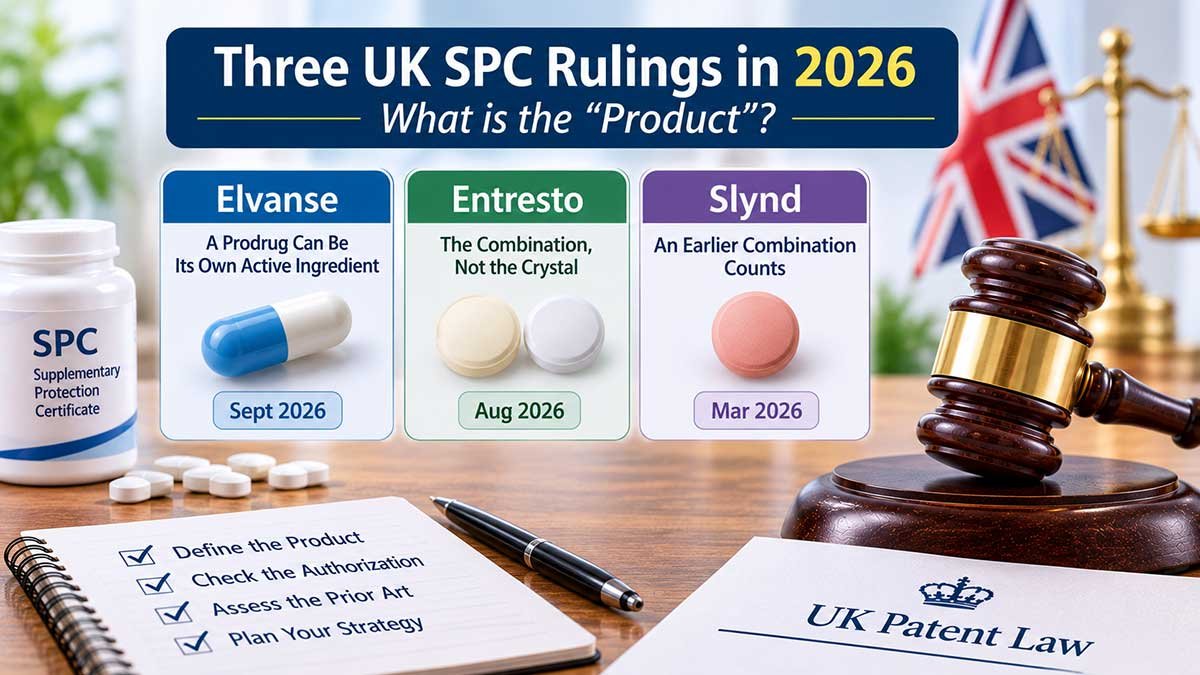
Three UK decisions from 2026 show how much can turn on how the product is defined. In two of them, a careful reading of the marketing authorization saved the SPC. In the third, an earlier combination product sank it.
Elvanse: a prodrug can be its own active ingredient (September 2026)
Aristo Pharma GmbH v. Takeda Pharmaceuticals [2026] EWHC 2414 (Pat)
Elvanse, Takeda’s ADHD treatment, contains lisdexamfetamine (LDX). LDX is a prodrug: dexamfetamine (DEX) attached to the amino acid lysine. In the body, the lysine is cleaved off and DEX does the work. DEX itself has been on the market for decades.
Aristo and Stada, in parallel actions, argued that DEX, not LDX, was the real active ingredient of Elvanse. If that were right, the Elvanse authorization would not be the first authorization for the product, and Takeda’s SPC would fail Article 3(d).
His Honour Judge Hacon disagreed and upheld the SPC. He applied the test from the CJEU’s Forsgren decision: a substance is an active ingredient if it has a pharmacological, immunological or metabolic action of its own. LDX met that test. Its pharmacokinetic profile is materially different from DEX, and that difference has real clinical value: LDX can be taken once a day, where DEX needs two or three doses. Unchallenged regulatory evidence showed this was a clinically significant advantage.
The judge also looked closely at the marketing authorization itself. Read as a whole, together with the regulator’s Public Assessment Report, it would lead a reasonable reader to treat LDX as the active ingredient. Statements that LDX is “pharmacologically inactive” referred only to its inactivity in the test tube. The judge held that the “active substance” test under the medicines legislation and the “active ingredient” test under the SPC Regulation are the same, and drew support from Advocate General Emiliou’s opinion in the pending Halozyme reference to the CJEU, which looks to how the marketing authorization classifies the active ingredient.
The UK result is not the only one. Germany’s Federal Patent Court invalidated the German SPC in 2024, a decision under appeal, while courts in Denmark, Sweden and Switzerland have found for Takeda. A further CJEU reference on whether an approved prodrug of an existing active can qualify for its own SPC is also pending.
Entresto: the combination, not the crystal (August 13, 2026)
Accord Healthcare Ltd v. Novartis AG [2026] EWHC 2127 (Pat)
Novartis’s SPC for Entresto describes the product as “Sacubitril/valsartan, including pharmaceutically acceptable salts thereof.” The basic patent, EP 1 467 728, expired on January 16, 2023, and the SPC runs to January 15, 2028.
The complication is that Entresto is not a simple mixture of two drugs. It is a crystalline co-complex of valsartan and sacubitril with sodium ions and water. Meade J described it, “in crude terms,” as “a salt of valsartan and a salt of sacubitril physically stuck together by their inclusion in the co-complex.” Accord planned to launch a conventional mixture of the two salts.
Accord attacked the SPC from both sides. If the product was the co-complex, the basic patent did not protect it, so Article 3(a) failed. If the product was the broader combination, the marketing authorizations covered only the co-complex, so Article 3(b) failed.
Meade J rejected both arguments, and the answer turned on identifying the product correctly. The regulatory materials, including the summary of product characteristics, explain that Entresto dissociates into valsartan and sacubitril after it is taken, and treat those two as the active substances. As the judge put it, “the active ingredients are valsartan and sacubitril and not the co-complex.”
Once the product was the combination, the rest followed. Under Article 3(a), the combination was repeatedly identified in the patent and its claims, and the claims did not require the two drugs to be in a simple mixture. That the co-complex itself could not be identified from the patent was, in the judge’s words, “true but irrelevant given that the co-complex is not the product.” A later Novartis patent on the co-complex did not change this, because a new formulation can be inventive without being a different SPC product. Under Article 3(b), the Entresto authorizations were enough for the combination, even though they related to one physical form. Following the CJEU’s Farmitalia decision, a change of salt or form does not create a new product.
Slynd: an earlier combination counts (March 20, 2026)
Laboratorios Leon Farma SA v. Comptroller-General of Patents [2026] EWHC 663 (Ch)
Slynd is an oral contraceptive whose only active ingredient is drospirenone. Its novelty is what it leaves out: unlike older pills, it contains no estrogen. Leon’s basic patent, EP 3 632 448, claims a drospirenone composition without any estrogen, and the UK IPO accepted that Articles 3(a) to 3(c) were met.
The problem was Article 3(d). Drospirenone had been on the market years earlier, combined with estrogens, in Angeliq (with estradiol) and Yasmin (with ethinyl estradiol). The IPO refused the SPC because the Slynd authorization was not the first to put drospirenone on the market. Leon appealed, and Recorder Douglas Campbell KC dismissed the appeal.
The key authority was the CJEU’s Medeva decision, which treats an authorization for a combination “A+B” as an authorization to place A, and B, on the market. Leon tried to confine Medeva in three ways:
- It applies only to multi-disease vaccines or products aimed at different therapeutic targets.
- It governs Article 3(b), not Article 3(d).
- Later case law has quietly undermined it.
All three failed. The judge read Medeva as a general principle, not limited to vaccines, and held that “product” must mean the same thing throughout Article 3. None of the later cases had overruled it. In particular, the CJEU’s later Teva decisions, which treat A+B as a different product from A alone for Articles 3(a) and 3(c), addressed the opposite situation and did not conflict with it.
Leon also asked for the product to be described as “drospirenone (not containing any estrogen).” The judge refused. That wording describes the absence of another ingredient, not a different active ingredient. Nor would he weigh the novelty or therapeutic value of the estrogen-free formulation: in his view, the balance of interests is struck by the terms of the Regulation itself.
The result is harsh for innovators who improve an old drug by taking something out, but it keeps UK law aligned with the existing EU case law.
What this means in practice
Define the product consistently, and back it with the authorization. In both Elvanse and Entresto, the SPC survived because the marketing authorization and the product literature identified the active ingredient in a way that matched the SPC. Regulatory and patent teams should agree on what the product is and make sure the summary of product characteristics supports that choice.
Form is rarely the product. A salt, a crystal form or a co-complex will usually not count as a different product from the active ingredients it contains. That helps patentees defending an SPC against a generic with a different form, as in Entresto. It also limits SPCs for new formulations of old drugs.
Prodrugs can stand on their own, for now. Elvanse shows that a prodrug with its own clinically meaningful pharmacokinetic profile can be a separate active ingredient. But courts in Europe have split on the same SPC, and two CJEU references bearing on the question are pending.
An earlier combination can block a later single-ingredient SPC. Under Medeva, as applied in Slynd, an authorization for A+B is treated as an authorization for A. Companies developing a single-ingredient product from a drug already sold in combination should not count on an SPC for it in the UK, however innovative the change.