Nov 19, 2026
This post draws on “Recent Updates in U.S. Patent Law: Key Decisions and Takeaways for Pharma & Biotech 2026,” presented by Roshan P. Shrestha, Ph.D., Partner, Taft, on November 16, 2026 @ipEssentia Webinar series.
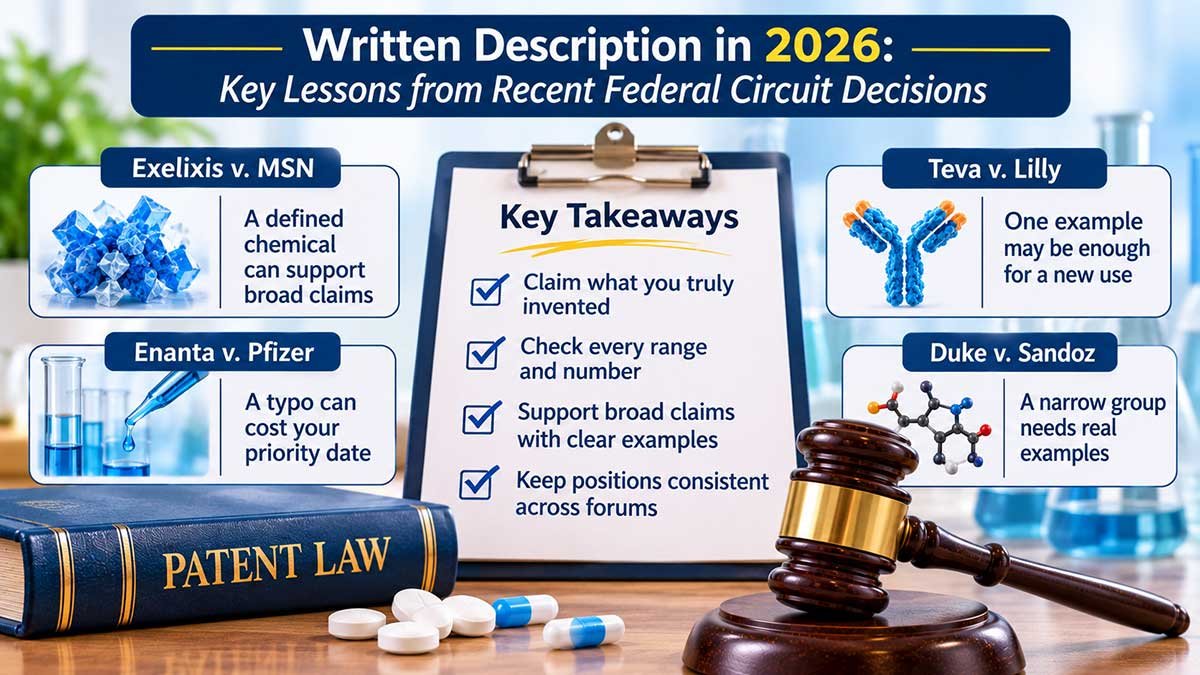
The written description requirement in 35 U.S.C. § 112(a) gets less attention than obviousness or enablement. Over the past year, though, it has decided several important pharma appeals at the Federal Circuit. It wiped out a $39 million jury verdict in Duke v. Sandoz. It cost Enanta the early filing date it needed to beat Pfizer’s publication. And it saved Exelixis’s broad claims to the crystalline salt in its cancer drug Cabometyx.
The test in every case is the same. Reading the patent as of its filing date, would a skilled scientist see that the inventor actually had what is now being claimed? The recent decisions show that the answer depends heavily on what kind of claim is at stake. Broad claims tied to a clearly defined chemical, or to a new use of a well-understood class of drugs, have held up. Claims to a narrow slice of a huge chemical family, and claims that rely on a sloppy earlier filing, have not.
Exelixis v. MSN (Fed. Cir. Aug. 31, 2026)
Exelixis sells Cabometyx, a cabozantinib (L)-malate tablet for kidney, liver, and thyroid cancers. Its 2015 FDA filing reported two crystal forms of the salt, called N-1 and N-2. Exelixis later obtained three patents (U.S. Patent Nos. 11,091,439, 11,091,440, and 11,098,015) that claim the crystalline salt in general, not just those two forms.
MSN’s generic uses a third crystal form, form S, which MSN has patented itself. MSN agreed that form S falls within Exelixis’s claims. Its defense was that describing two crystal forms does not entitle Exelixis to claim every crystal form.
The District of Delaware disagreed after a trial, and the Federal Circuit affirmed in a precedential opinion by Judge Stoll. Under the court’s Ariad framework, a patent can support a broad group of compounds (a “genus”) in one of two ways: by describing enough individual examples, or by describing structural features that all members of the group share. Here, the chemical name, the formula, and the requirement that the salt be crystalline were enough. The claims also required a crystalline structure, so they reached no further than what the patent described.
MSN argued that the two disclosed crystal forms have different physical properties, so they could not stand in for every other form. The court rejected this because MSN never explained why those differences, which the claims do not mention, mattered to the analysis.
The takeaway: written description is not only a weapon for generic companies. When a claim is tied to a precise chemical identity, a small number of examples can support it.
Enanta v. Pfizer (Fed. Cir. June 23, 2026)
Enanta shows what can go wrong between a provisional application and the patent that follows it.
In July 2020, Enanta filed a provisional application on compounds that block coronavirus replication. It described one part of the molecule as having a carbon chain of two to twelve carbons (“C2–C12”). On April 6, 2021, Pfizer publicly disclosed nirmatrelvir, the active ingredient in Paxlovid, which has a one-carbon group in that spot. Enanta later said the “C2” had been a typo for “C1.” Its full application, filed in November 2021, said C1–C12 and became U.S. Patent No. 11,358,953.
The filing date decided the case. If Enanta could rely on the July 2020 provisional, Pfizer’s 2021 disclosure came too late to count against it. If not, Pfizer’s disclosure anticipated the claims, and Enanta did not argue otherwise. The District of Massachusetts ruled for Pfizer on summary judgment.
The Federal Circuit affirmed in a precedential opinion by Judge Lourie, joined by Judges Bryson and Chen. The court treated the issue as one of written description, not of fixing a typo. To claim the earlier date, the provisional itself had to show that Enanta possessed the one-carbon version. It did not. A range of two to twelve carbons leaves out one carbon, just as describing ethanol does not describe methanol. Because it was reasonably debatable whether “C2” was a mistake at all, the rules for correcting obvious errors did not apply.
Enanta’s expert pointed to other passages in the provisional that mentioned one to twelve carbons. Those passages were general definitions, not the specific description that mattered, so they did not help. In the court’s words, applicants “did not invent what they did not disclose.”
Teva v. Lilly (Fed. Cir. Apr. 16, 2026) and Duke v. Sandoz (Fed. Cir. Nov. 18, 2025)
These two cases are worth reading together, because similar-looking questions came out opposite ways.
Teva v. Lilly. Teva sued Lilly in the District of Massachusetts, claiming that Lilly’s migraine drug Emgality infringed Teva’s “headache patents.” These patents claim a method of treating headache with a human or humanized anti-CGRP antibody. They do not claim the antibodies themselves. The patent described only one humanized antibody. The jury found willful infringement, but the trial judge overturned the verdict, ruling the claims invalid for lack of written description and enablement.
The Federal Circuit reversed in a precedential decision (Judges Prost and Cunningham, and District Judge Andrews). The court saw the invention as a new use for a well-known class of antibodies, not as a new antibody. For that kind of claim, one good example plus standard methods for making others could be enough. On enablement, the court noted that the Supreme Court’s Amgen v. Sanofi decision involved claims to the antibodies themselves, which these claims were not.
Lilly’s own earlier arguments worked against it. At the Patent Office, Lilly had challenged Teva’s separate antibody patents by arguing that these antibodies were well known and that humanizing them was “a well-established and routine procedure.” Those arguments won there. In court, they made it hard for Lilly to argue that the field was too unpredictable for one example to be enough.
Duke v. Sandoz. Duke University and Allergan sued Sandoz over its generic version of Latisse, the eyelash-growth product containing bimatoprost. The asserted claim 30 of U.S. Patent No. 9,579,270 covered a subgroup of prostaglandin compounds with a particular combination of chemical groups at each end of the molecule. Sandoz admitted infringement but argued the claim was invalid. A Colorado jury disagreed and awarded $39 million.
The Federal Circuit reversed in an opinion by Judge Stark, joined by Judges Dyk and Stoll, holding that no reasonable jury could have found adequate written description. The patent did not name a single compound within claim 30. Allergan pointed to features the compounds share, but one of them, the prostaglandin “hairpin” shape, is common to every prostaglandin and so did not set this group apart. The patent also listed 13 options for one position on the molecule and singled out five as preferred. The option claim 30 requires was not one of them. Getting from the patent to the claimed compounds meant following what the court called a “maze-like path.”
The difference comes down to what was claimed. Teva claimed a new use for a known, well-studied class of molecules. Allergan claimed a narrow group of compounds buried in a vast disclosure, with no examples, and against the patent’s own stated preferences.
In re Xencor (Fed. Cir. Mar. 13, 2025)
This earlier decision deals with Jepson claims, an old claim format that begins by reciting what is already known and then adds “the improvement comprising” the new feature. Xencor used this format to claim treatment with anti-C5 antibodies carrying specific changes to the antibody’s Fc region. It argued that only the new feature needed written description support.
The Federal Circuit disagreed. The opening part of a Jepson claim is still part of the claimed invention, so the patent must show that what it calls well known really is. As the court put it, a patentee cannot simply state that a time machine is well known without describing one. The court also held that the words “treating a patient” limited the related method claim, and that Xencor’s application did not show it had treated any particular disease with these antibodies.
What this means in practice
When drafting claims. Be precise about what you are claiming. A broad claim tied to a well-defined chemical, or a method claim built on a well-understood class of drugs, can be supported by a few examples. A claim to a narrow subgroup picked from a huge chemical family needs real examples or clear guidance pointing to that subgroup. It should not contradict the patent’s own stated preferences.
When filing provisionals. Check every range, number, and chemical group before filing. Then confirm that each later claim has support in every application in the chain. A later “correction” may be treated as something the provisional never described, and a publication in the meantime can turn a typo into an invalid patent.
When litigating. Keep your positions consistent across forums. Arguing at the Patent Office that a field is routine and well known can make it very hard to argue in court that the same field is too unpredictable.