Nov 19, 2026
This post draws on “Recent Updates in U.S. Patent Law: Key Decisions and Takeaways for Pharma & Biotech 2026,” presented by Roshan P. Shrestha, Ph.D., Partner, Taft, on November 16, 2026 @ ipEssentia Webinar Series 2026.
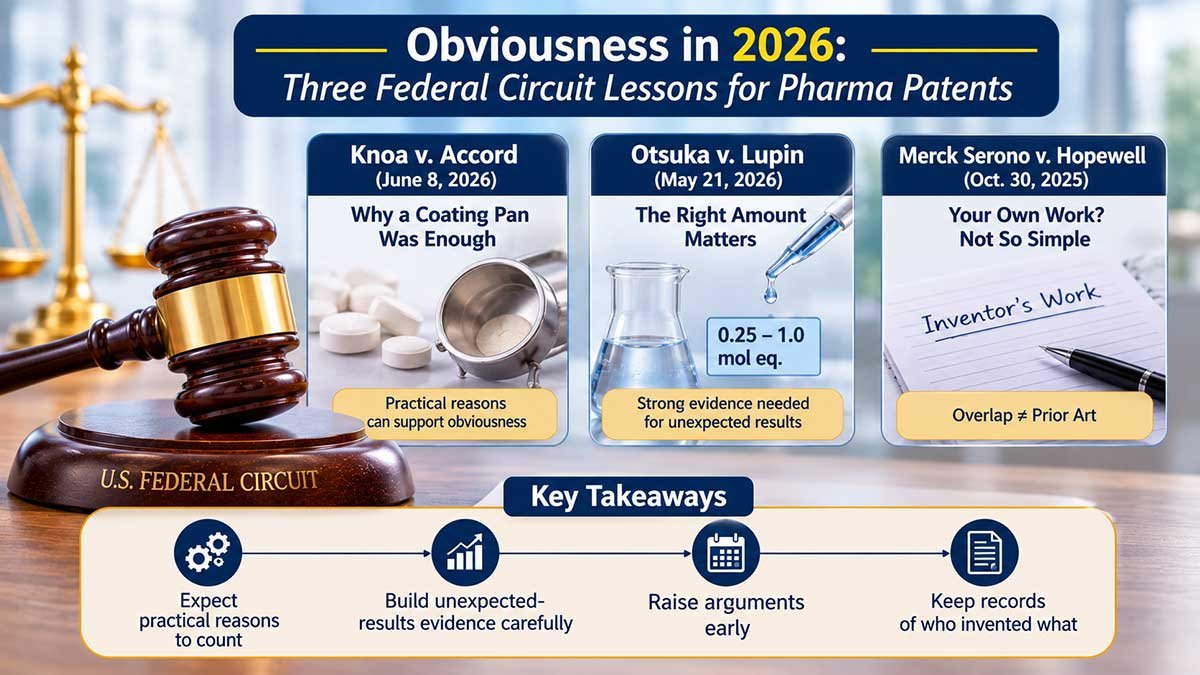
Obviousness under 35 U.S.C. § 103 is one of the main battlegrounds in generic drug litigation, and three recent Federal Circuit decisions show how it plays out in practice. In each one, the patent owner lost. The decisions turn less on new legal rules than on evidence, and they offer clear lessons about it: what counts as a reason to change the prior art, when evidence of unexpected results is strong enough to matter, and when an earlier publication counts as prior art at all.
The three cases involve an abuse-deterrent opioid tablet, a cleaner way to make a kidney drug, and a dosing schedule for a multiple sclerosis drug.
Knoa v. Accord (Fed. Cir. June 8, 2026)
The original OxyContin could be crushed and snorted, or dissolved and injected, releasing oxycodone much faster than intended. Purdue’s reformulated version resists that kind of abuse. It uses polyethylene oxide (PEO), a polymer, and heats the tablets so they harden and resist crushing.
The patent at issue, U.S. Patent No. 11,304,908, is owned by Knoa Pharma, formerly Purdue Pharmaceuticals. Its claim 18 covers an extended-release oxycodone tablet made from a PEO matrix that is heated “in a coating pan” for at least about 5 minutes at about 60°C or more. A coating pan is a standard piece of tablet-manufacturing equipment, normally used to apply coatings. Accord filed for approval of a generic OxyContin, admitted infringement, and argued the claim was obvious.
The key prior art was a reference called Bartholomäus. It already taught an abuse-deterrent opioid tablet containing PEO, hardened by heat. The difference was the equipment: Bartholomäus heated its tablets in a heated tablet press, which does not scale well to commercial production. Claim 18 requires a coating pan.
After a bench trial in Delaware, Judge Bryson found the claim obvious, and the Federal Circuit affirmed in an opinion by Chief District Judge Seeborg, sitting with Judges Hughes and Stoll. Accord’s expert testified that coating pans, ovens and fluid bed dryers were common equipment that could handle large batches. A coating pan was especially attractive because the same equipment could first cure the tablets and then coat them. The trial judge found her credible, and the appeals court deferred to that finding.
Purdue’s other arguments did not get far. It said the trial court had blurred claim 18’s coating-pan requirement into a broader heating requirement, but the court had addressed the coating pan separately. Purdue’s challenge to reasonable expectation of success amounted to asking the appeals court to reweigh the evidence. And Purdue’s argument that the invention met a long-felt need for scalable, commercially practical tablets came too late: it had not been raised properly below. It also did not match the claim, which covers a tablet, not a manufacturing process.
The lesson: when the prior art already solves the core problem, choosing standard equipment to make it at scale is likely to be seen as an obvious step, especially when an expert can point to a practical reason, like efficiency, for that choice.
Otsuka v. Lupin (Fed. Cir. May 21, 2026)
Otsuka sells Jynarque (tolvaptan) for a form of polycystic kidney disease. Older ways of making tolvaptan produced an unwanted impurity. Otsuka found that using less of one reagent, sodium borohydride, in a key reaction step reduced that impurity. Its U.S. Patent No. 8,273,735 claims this process, using 0.25 to 1 (or 0.25 to 0.5) molar equivalents of the reagent for each mole of the starting compound. A related patent, U.S. Patent No. 8,501,730, claims highly pure tolvaptan made this way.
Lupin’s process uses at least 1.2 molar equivalents, more than the claims allow. Otsuka argued that the reaction is effectively finished before the extra reagent makes any difference, so Lupin still practices the claims. After a bench trial, Judge Andrews of the District of Delaware found no infringement of either patent and held the ‘735 process claims obvious. The Federal Circuit affirmed in a nonprecedential opinion by Judge Hughes, joined by Judge Cunningham and District Judge Burroughs.
Infringement. Otsuka had to prove two things: that Lupin’s reaction was practically complete by the time it was stopped, and that no more than 1 molar equivalent had been added by then. It proved neither. Its expert relied on two experiments that the court found unreliable and that were run under conditions different from Lupin’s actual process. Otsuka also tried to challenge the qualifications of Lupin’s expert, but it had not raised that objection at trial, so it was forfeited.
Obviousness. Both sides agreed that a 1999 article by Kondo and colleagues taught the overall route to tolvaptan, using 1.5 molar equivalents of sodium borohydride in the key step. Lupin’s expert gave concrete reasons a chemist would cut that amount: lower cost, better safety, simpler cleanup after the reaction, and the fact that the reagent was already used in excess.
Otsuka argued that the purity and yield it achieved were unexpected. The court was not persuaded. Otsuka’s expert had based his comparison on experiments using double the reagent, not on Kondo’s actual method, so the comparison did not show an improvement over the closest prior art. The court added that weak evidence of this kind generally cannot overcome a strong case of obviousness.
The lesson for patent owners: to prove unexpected results, compare the invention with the closest prior art as it was actually practiced. To prove infringement, test the accused process itself, under its real conditions.
Merck Serono v. Hopewell (Fed. Cir. Oct. 30, 2025)
The oldest of the three cases turns on a question that comes before obviousness: does a particular earlier publication count as prior art at all?
Merck holds patents on specific oral dosing regimens of cladribine for treating multiple sclerosis. Hopewell challenged them in inter partes review at the Patent Trial and Appeal Board, arguing they were obvious over two references. One was a patent application by Bodor; the other, a publication by Stelmasiak. Both disclosed similar cladribine dosing schedules.
Merck’s answer was that the key passage in Bodor was not prior art, because it reflected the work of Merck’s own inventors. Under the patent law that applied before the America Invents Act, an inventor’s own earlier work is not prior art against them; only work “by another” is. Merck said one of its named inventors, De Luca, had contributed the dosing passage in Bodor.
The Board rejected that argument and found the claims obvious. In a precedential opinion by Judge Linn, joined by Judges Hughes and Cunningham, the Federal Circuit affirmed. The court applied a long-standing rule from In re Land: an earlier disclosure escapes being prior art only if it reflects the work of exactly the same inventive entity as the patent. If the patent names even one inventor more or one fewer than the people behind the earlier passage, that passage is work “by another.” Partial overlap is not enough. Merck also needed objective, corroborated evidence, such as lab notebooks, dated emails or invention disclosures, showing that the patent’s inventors as a group were responsible for the passage. It did not have that evidence.
The court also rejected Merck’s claim construction arguments and upheld the Board’s obviousness ruling.
The lesson: if you plan to argue that a reference is your own work, you need contemporaneous records showing who contributed what. Overlapping names on two documents will not carry the argument.
What this means in practice
Expect practical reasons to count. Cost, safety, scale and manufacturing efficiency are exactly the kinds of reasons courts accept for changing the prior art. In Knoa and Otsuka, ordinary commercial motives were enough to explain why a skilled person would make the claimed change.
Build unexpected-results evidence carefully. Compare the invention with the closest prior art as it was actually described and practiced, not with a modified version. Weak or mismatched comparisons will not rescue a claim facing a strong obviousness case.
Raise arguments early. In Knoa, the long-felt need theory came too late on appeal. In Otsuka, the objection to the other side’s expert was lost because it was not made at trial.
Keep records of who invented what. For patents governed by pre-AIA law, excluding your own earlier publication as prior art requires proof that exactly the same inventors were behind it. That proof has to come from records made at the time.